

Abundance or unique sequences?
A repertoire is a list of distinct sequences, CDR3s for example, each carried by some number of cells (templates, UMIs, reads). When you build a model you choose how much each sequence counts, and that choice defines what the model describes.
BeamModel(sequences, abundances=counts) # weighted: each CELL countsBeamModel(sequences) # unique: each distinct SEQUENCE counts onceWhat each describes
Section titled “What each describes”Weighted by abundance, the model describes the cells: its probability for a sequence is the chance that a cell drawn at random carries it. Expanded clones count as many times as they have cells.
Unique sequences, the model describes the sequence composition of the repertoire: which CDR3s are present, regardless of how much each was expanded.
import numpy as npimport BEAMfrom BEAM import BeamModel# seqs: the distinct CDR3s of one repertoire; counts: how many cells carry eachby_cells = BeamModel(seqs, abundances=counts)    # each cell counts: describes the cellsby_sequence = BeamModel(seqs)                    # each distinct sequence counts once
top = seqs[int(np.argmax(counts))]print(f"largest clone {top}: {max(counts) / sum(counts):.2%} of the cells")print(f"P(largest clone) weighted by cells: {by_cells.pseq(top):.2e} " f"unique: {by_sequence.pseq(top):.2e}")print(f"distinct sequences: {len(seqs):,} cells: {sum(counts):,}")largest clone CATSDFRRGLAGGPYEQYF: 2.85% of the cellsP(largest clone) weighted by cells: 3.42e-02 unique: 6.72e-12distinct sequences: 48,964 cells: 2,347,888The largest clone holds 2.9% of this stand-in repertoire’s cells (stand-in population A, with clonal expansion added), and the weighted model gives it a probability of 3.4%, close to that share. The two need not agree exactly: the model builds probabilities from overlapping stretches of sequence rather than storing each sequence’s frequency, which is also what lets it score sequences it has never seen. To the unique model it is one sequence among 48,964, and its probability, about , reflects only its sequence.
Clonal expansion
Section titled “Clonal expansion”Clonal expansion is a response to antigen: a few T cells divide and fill a large part of the repertoire. Whether it should influence the model depends on the question.
Clonal expansion and the two kinds of model
Loading…
Drag the slider to make the clones of one stand-in repertoire more expanded. The numbers show how much of the repertoire the largest clones take, the largest clone's probability under each model, and the distance between the weighted and the unique model. The chart shows each model's length distribution: the weighted model follows the expanded clones, the unique model does not move.
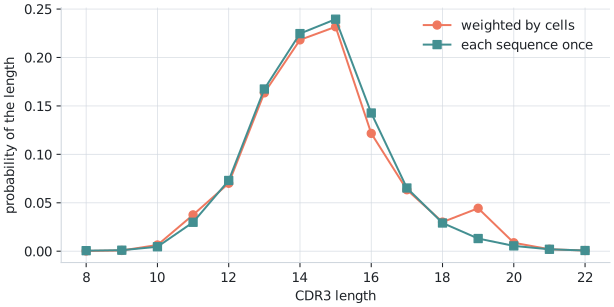
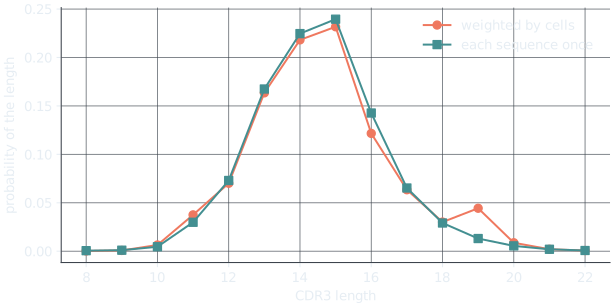
Two repertoires of the same population, one with expanded clones and one without, look very different weighted by cells and similar counted by unique sequences:
from BEAM import BeamModelfrom BEAM.analytics.distance import compare# two repertoires of the same population (sequences s1, s2 and their clone sizes c1, c2):# donor 1 has large expanded clones, donor 2 does notweighted = compare(BeamModel(s1, abundances=c1, order=3),                   BeamModel(s2, abundances=c2, order=3))unique = compare(BeamModel(s1, order=3), BeamModel(s2, order=3))
print(f"distance, weighted by cells: {weighted.distance:.4f}")print(f"distance, each distinct sequence once: {unique.distance:.4f}")distance, weighted by cells: 0.5821distance, each distinct sequence once: 0.1564Weighted by cells, the expanded clones make the two stand-in repertoires almost four times as distant as when each distinct sequence counts once. The size of the effect depends on how strongly the clones are expanded; the explorer above shows the whole range. If the question is whether two people’s repertoires differ in composition, the weighted distance is mostly measuring expansion.
Benefits and drawbacks
Section titled “Benefits and drawbacks”| Weighted by abundance | Unique sequences | |
|---|---|---|
| Describes | what the abundances count: cells (templates, UMIs) or reads | the sequence composition |
| Clonal expansion | dominates the model | no longer weighted, though it still takes up depth and decides which sequences were seen |
| Depends on depth | little: more cells sharpen the same distribution | strongly: deeper samples add rare, often longer, sequences, so compare at an equal number of distinct sequences |
| Differences in abundance units (templates, UMIs, reads) between platforms | carried into the model | removed |
| Sampling questions (depth, overlap, publicness) | in cells, as sequenced | in distinct sequences, not cells |
| Frequencies of individual sequences | kept | lost |
| Best for | how a sample of cells will look; expanded responses; the population as sampled | comparing repertoires’ composition across samples, studies and platforms |
Use abundance weighting when the question is about cells: how many distinct sequences a sample of cells will contain, how many people will carry a sequence at a given sequencing depth, how an expanded response changes a repertoire. The reference model is weighted by template counts where the platform reported them, and counts each distinct sequence once per repertoire otherwise.
Use unique sequences when the question is about which sequences a repertoire contains, and compare repertoires at the same number of distinct sequences, as the paper did: comparing cell types, conditions or studies, especially across platforms whose abundance units differ, or when a few expanded clones would otherwise decide the comparison. The paper’s comparison of CD4 and CD8 repertoires across two independent studies counted each distinct sequence once for this reason.