

Generating sequences
The question: what do sequences from this population look like, and can I get new ones to use as a background or a null set?
Drawing sequences
Section titled “Drawing sequences”sample draws sequences in proportion to their probability: a sequence twice as
probable is drawn twice as often. Give length to draw only sequences of that length.
seed chooses the draw: the same seed always gives the same sequences, and leaving it out
uses seed 0, so two calls without a seed return the same draws. Pass different seeds for
independent draws, for example two null sets.
import BEAM
model = BEAM.load_pretrained("human_tcrb_cdr3_aa_foundation")
print(model.sample(5, seed=1)) # any lengthprint(model.sample(5, length=12, seed=1)) # exactly 12 residues['CASSPGTSSDTYEQYF', 'CASSLGTYSYNEQFF', 'CASRPGNSPLHF', 'CSVLKSGTPGEKLFF', 'SVGSGVNIGEQYF']['CALLTENYGYTF', 'CASSLFDRGGYE', 'CASNHSNQPQHF', 'CASSVDRGEQYV', 'CSAPRGFDGYTF']Sequences with their probabilities
Section titled “Sequences with their probabilities”simulate draws the same way and also returns each sequence’s log probability, which saves
scoring them afterwards.
import BEAM
model = BEAM.load_pretrained("human_tcrb_cdr3_aa_foundation")draws = model.simulate(4, seed=3)
for cdr3, logp in zip(draws.sequences, draws.log_probs): print(f"{cdr3:20} log P = {logp:.3f}")CSARQSSYEQYF log P = -14.110CASSSNRVRTGELFF log P = -18.039CASSPGPIKNTGELFF log P = -19.780CASSLGTSGDHRELFF log P = -22.735The draws follow the model
Section titled “The draws follow the model”Draw many sequences and their lengths follow the model’s length distribution, as they should:
from collections import Counterimport BEAM
model = BEAM.load_pretrained("human_tcrb_cdr3_aa_foundation")draws = model.sample(50_000, seed=11)
observed = Counter(len(s) for s in draws)expected = model.length_distributionprint("length sampled share model probability")for L in range(10, 20): print(f"{L:6} {observed[L] / len(draws):13.4f} {expected[L]:17.4f}")length sampled share model probability 10 0.0050 0.0048 11 0.0303 0.0308 12 0.0769 0.0768 13 0.1704 0.1712 14 0.2264 0.2254 15 0.2370 0.2370 16 0.1373 0.1374 17 0.0649 0.0650 18 0.0290 0.0289 19 0.0126 0.0124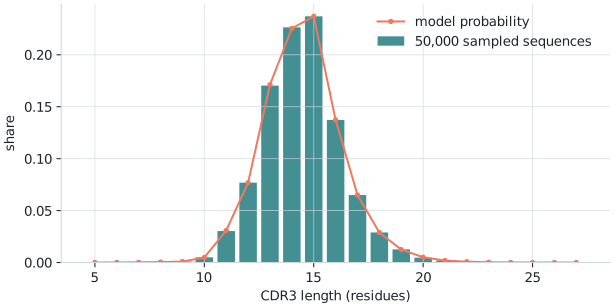
Sampling in motion
Loading…
Press Draw to watch sequences being drawn from the reference model, newest first, with their log probabilities. The bars show the share of each length among the draws so far; the dots are the model's length distribution, computed rather than sampled, which the bars approach as draws accumulate.
Not every draw is a textbook CDR3
Section titled “Not every draw is a textbook CDR3”The reference model gives some probability to every sequence of up to 27 residues, including sequences it has never seen. Most of what it draws has the conserved start and end, but not all:
import BEAM
model = BEAM.load_pretrained("human_tcrb_cdr3_aa_foundation")draws = model.sample(50_000, seed=11)
starts_c = sum(s.startswith("C") for s in draws) / len(draws)ends_fw = sum(s.endswith(("F", "W")) for s in draws) / len(draws)print(f"start with C: {starts_c:.1%}")print(f"end with F or W: {ends_fw:.1%}")start with C: 98.0%end with F or W: 96.9%That is a little below the corpus the reference model was built from, in which, according to the paper’s Methods, 99.6% of sequences start with C and 98.6% end with F or W. The model reserves some probability for sequences it never observed, and some of that goes to non-canonical ones. Filter the draws if your use needs canonical CDR3s only.