

How likely is a sequence?
The question: how probable is this sequence in a population, and why?
A BEAM model gives every sequence a probability: the chance that one sequence drawn at random from the population the model describes is exactly that one. With the reference model, it is the chance that one T cell drawn at random from the 38,538 human repertoires it was built from has exactly that CDR3β; the examples on this page use it.
One sequence, or a few
Section titled “One sequence, or a few”pseq returns the probability; pseq(..., log=True) and log_pseq_batch return its natural
logarithm, which is easier to compare because CDR3 probabilities are tiny.
import BEAM
model = BEAM.load_pretrained("human_tcrb_cdr3_aa_foundation")
# One sequence: a probability, or its natural logarithm.print(model.pseq("CASSLGQGYEQYF"))print(model.pseq("CASSLGQGYEQYF", log=True))
# Many sequences at once.cdr3s = ["CASSLGQGYEQYF", "CASSPGTGELFF", "CSARDRTGNGYTF"]for cdr3, logp in zip(cdr3s, model.log_pseq_batch(cdr3s)): print(f"{cdr3:16} log P = {logp:7.3f}")3.29567201803869e-05-10.320315366964564CASSLGQGYEQYF log P = -10.320CASSPGTGELFF log P = -10.453CSARDRTGNGYTF log P = -12.019A log probability of −10.3 is a probability of about 3 × 10⁻⁵: roughly 3 cells in every 100,000 carry this sequence.
Millions of sequences
Section titled “Millions of sequences”log_pseq_batch scores a whole list in one call and is the way to score a
repertoire.
import numpy as npimport BEAM
model = BEAM.load_pretrained("human_tcrb_cdr3_aa_foundation")
# A large batch: 200,000 sequences, here drawn from the model itself.cdr3s = model.sample(200_000, seed=7)logp = model.log_pseq_batch(cdr3s)
print(f"scored {len(logp):,} sequences")print(f"median probability: {np.exp(np.median(logp)):.2e}")print(f"5% are rarer than: {np.exp(np.percentile(logp, 5)):.2e}")scored 200,000 sequencesmedian probability: 9.85e-095% are rarer than: 1.05e-13Half of the sequences have a probability below about 10⁻⁸. That is the typical scale: most CDR3s are individually rare, and only a small set of sequences reach 10⁻⁵ or above.
Comparing sequences of different lengths
Section titled “Comparing sequences of different lengths”A longer CDR3 is usually less probable, partly because it is longer and partly because long CDR3s are rarer to begin with. The two parts separate exactly:
where is the probability of the length and the probability of the sequence
among all sequences of that length. length_distribution gives .
import BEAM
model = BEAM.load_pretrained("human_tcrb_cdr3_aa_foundation")p_length = model.length_distribution          # {length: probability}
for cdr3 in ["CASSLGQGYEQYF", "CASSLGQGAYNEQFF", "CASSPRDRGLAGGYNEQFF"]: p = model.pseq(cdr3) L = len(cdr3) print(f"{cdr3:20} L={L} P(s) = {p:.2e} P(L) = {p_length[L]:.3f}" f" P(s | L) = {p / p_length[L]:.2e}")CASSLGQGYEQYF L=13 P(s) = 3.30e-05 P(L) = 0.171 P(s | L) = 1.93e-04CASSLGQGAYNEQFF L=15 P(s) = 6.44e-06 P(L) = 0.237 P(s | L) = 2.71e-05CASSPRDRGLAGGYNEQFF L=19 P(s) = 1.60e-09 P(L) = 0.012 P(s | L) = 1.28e-07The 19-residue sequence is about 20,000 times less probable than the 13-residue one. Only about 14 times of that comes from its length; the rest is the sequence itself. Comparing asks “how typical is this sequence for its length”.
Which residues drive a score
Section titled “Which residues drive a score”BEAM scores every residue twice, by two experts: one reads the sequence from the start, the other from the end. For residue of a sequence of length , using the neighbouring residues as context ( for the reference model):
- is the probability the expert reading from the start gives residue , from its position and the residues before it;
- is the same for the expert reading from the end, from the position counted from the end and the residues after it;
- is the residue’s combined factor: the geometric mean of the two, with weights ;
- is the probability of the length, and the normaliser: the product of the summed over every sequence of length .
explain returns all of these as natural logarithms: for each residue forward (),
backward () and combined (), and for the sequence log_length_prior
() and log_partition (). Below, each residue’s terms are shown as
surprisal in bits, : 0 means the residue was entirely expected, and each extra bit
means half as likely.
import mathimport numpy as npimport BEAM
model = BEAM.load_pretrained("human_tcrb_cdr3_aa_foundation")e = model.explain("CASSLGQGYEQYF")
bits = lambda log_p: -np.asarray(log_p) / math.log(2)          # surprisal, in bitsprint("  i  residue   from start   from end   combined (psi_i)")for i, (res, f, b, c) in enumerate(zip(e["residues"], bits(e["forward"]),                                       bits(e["backward"]), bits(e["combined"])), start=1):    print(f"{i:3}  {res:^7}  {f:11.2f}  {b:9.2f}  {c:17.2f}")
# ln P(s) = ln pi(L) - ln Z(L) + sum_i ln psi_itotal = e["log_length_prior"] - e["log_partition"] + e["combined"].sum()print(f"\nln pi(L) = {e['log_length_prior']:.3f} ln Z(L) = {e['log_partition']:.3f} " f"sum of ln psi_i = {e['combined'].sum():.3f}")print(f"ln pi(L) - ln Z(L) + sum of ln psi_i = {total:.6f}")print(f"log_pseq = {e['log_pseq']:.6f}") i residue from start from end combined (psi_i) 1 C 0.00 0.00 0.00 2 A 0.17 0.05 0.11 3 S 0.15 0.08 0.11 4 S 0.25 0.77 0.51 5 L 1.99 3.27 2.63 6 G 2.14 0.92 1.53 7 Q 3.08 3.41 3.24 8 G 0.91 3.24 2.08 9 Y 4.25 0.49 2.37 10 E 1.73 1.07 1.40 11 Q 0.14 0.15 0.15 12 Y 0.07 1.42 0.74 13 F 0.03 0.01 0.02
ln pi(L) = -1.765 ln Z(L) = -1.767 sum of ln psi_i = -10.322ln pi(L) - ln Z(L) + sum of ln psi_i = -10.320315log_pseq = -10.320315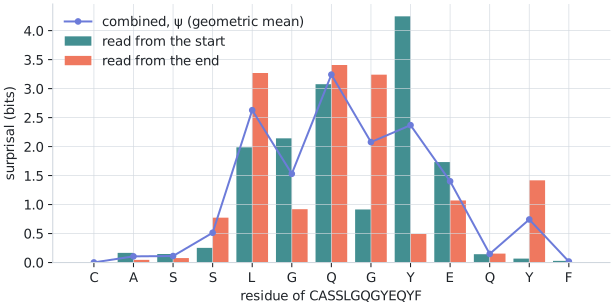
The reading from the start is sure of the opening CASS, the reading from the end is sure of
the closing Q and F, and both are uncertain in the middle (LGQGY), where the junction between
the gene segments makes CDR3s diverse. Where one expert is sure and the other is not, as at the
Y in position 9, the combined factor sits between them. The terms reconstruct the score
exactly, as the last lines show, so this is an explanation of the probability, not an
illustration of it.
A is a factor of the score, not a probability of the residue on its own: the product of the two experts is normalised as a whole, by . Because is the same for every sequence of length , the of different residues, or of one position in different sequences of the same length, can be compared directly.
What the model cannot score
Section titled “What the model cannot score”A sequence longer than the model’s maximum length (27 residues for the reference model), or
containing a character outside the model’s alphabet (the 20 standard amino acids for the
reference model), has probability 0. explain raises
an error that says why.
import BEAM
model = BEAM.load_pretrained("human_tcrb_cdr3_aa_foundation")
too_long = "CASS" + "G" * 30 + "YEQYF"     # 39 residues; the model covers up to 27unknown = "CASSLGQGXEQYF"                 # X is not one of the 20 amino acidsprint(model.pseq(too_long), model.pseq(unknown))
try: model.explain(unknown)except ValueError as err: print("explain:", err)0.0 0.0explain: sequence contains ['X'], which the 'aa' alphabet does not accept; its residues are 'ACDEFGHIKLMNPQRSTVWY'