

How many sequences will two samples share?
The question: if two samples are drawn from the same population, how many sequences will they have in common by chance alone?
Overlap between repertoires is often read as evidence of a shared response. Before reading it that way, it helps to know how much overlap independent samples of one population produce on their own. BEAM computes it directly from the model of the population, without simulation.
Two samples
Section titled “Two samples”sharing(d1, d2) is the expected number of sequences found in both of two independent samples of
depths d1 and d2.
import BEAMfrom BEAM.analytics.exact_occupancy import ExactOccupancy
model = BEAM.load_pretrained("human_tcrb_cdr3_aa_foundation")occupancy = ExactOccupancy(model)
print(" depth A depth B shared sequences share of A's distinct sequences")for a, b in [(1e5, 1e5), (1e5, 1e6), (1e6, 1e6), (1e7, 1e7)]: shared = occupancy.sharing(a, b).value distinct_a = occupancy.richness(a).value print(f"{a:9,.0f} {b:9,.0f} {shared:17,.0f} {shared / distinct_a:32.1%}") depth A depth B shared sequences share of A's distinct sequences 100,000 100,000 3,678 3.8% 100,000 1,000,000 14,633 15.1%1,000,000 1,000,000 82,670 9.4%10,000,000 10,000,000 1,090,052 15.1%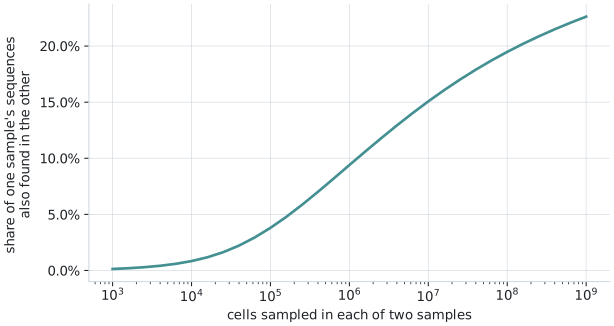
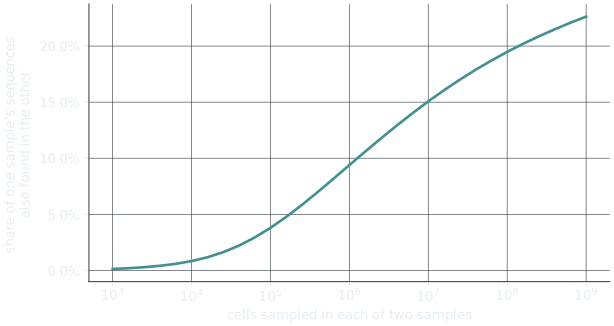
Two samples of 100,000 cells share about 3,700 sequences by chance, 3.8% of either sample’s distinct sequences. The overlap grows with depth: at ten million cells each, 15% of one sample’s sequences are expected in the other. A deeper second sample also raises the overlap: 100,000 cells against a million share 15% of the smaller sample’s sequences.
Private sequences in a cohort
Section titled “Private sequences in a cohort”private(depths) is the expected number of sequences found in exactly one sample of a cohort.
import BEAMfrom BEAM.analytics.exact_occupancy import ExactOccupancy
model = BEAM.load_pretrained("human_tcrb_cdr3_aa_foundation")occupancy = ExactOccupancy(model)
# A cohort of 10 people, each sampled to 100,000 cellsdepths = [100_000] * 10private = occupancy.private(depths).valueall_distinct = occupancy.richness(sum(depths)).value
print(f"distinct sequences across the cohort: {all_distinct:,.0f}")print(f"seen in exactly one person: {private:,.0f} ({private / all_distinct:.1%})")distinct sequences across the cohort: 879,776seen in exactly one person: 828,289 (94.1%)Across ten people sampled to 100,000 cells each, 94% of all distinct sequences are expected to be private to one person. Shared sequences are the exception, even by chance.
The same calculation predicts how many distinct sequences a cohort accumulates as it is pooled. In the paper, without any adjustment, the reference model built without the 768 Emerson donors predicted 98.9% of their observed pooled distinct-sequence count.